
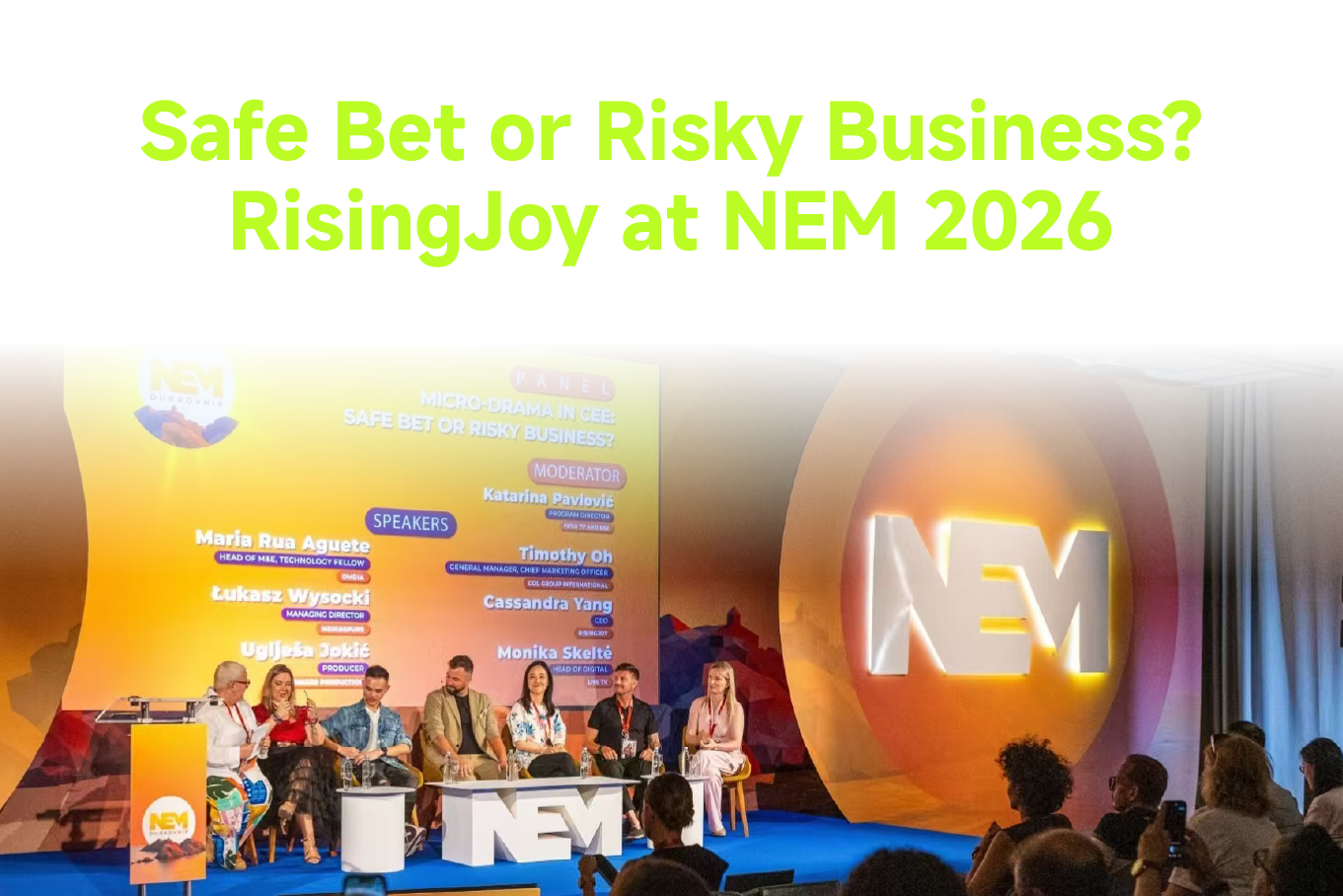
We came to NEM to learn about a new market. We left with much more.
RisingJoy CEO Cassandra Yang took the stage at New Europe Market (NEM) Dubrovnik 2026 for the panel "Micro-Drama in CEE: Safe Bet or Risky Business?" — a candid, wide-ranging discussion on whether Central and Eastern Europe is ready to move from observing the short-form wave to actively shaping it.
The big question
The panel tackled a central tension: micro-dramas are already reshaping content consumption globally, but structural questions remain in CEE around audience behavior, local storytelling traditions, platform strategies, monetization models, and brand opportunities. The rules are still being defined.
Voices from the panel
The discussion brought together a diverse set of perspectives:
-
Maria Rua Aguete, Head of Media & Entertainment and Technology Fellow at Omdia, framed micro-dramas as one of the most significant shifts in global content consumption. She noted that the global micro-drama market is projected to reach USD 14 billion in 2026, with USD 3 billion coming from outside China. "People like those 90-second episodes… and they pay by impulse," she said, adding that dual-screen behavior — audiences watching both big screens and mobile simultaneously — represents a structural shift, not a passing trend.
-
Timothy Oh, General Manager and Chief Marketing Officer at COL Group International, argued that the region isn't facing disruption so much as evolution. "People are already spending more time watching micro-dramas, vertical, than on Netflix by 40%," he said. But he cautioned that success requires native production logic: "Vertical is not essentially taking a camera and just shooting something vertically. It is very scripted, it is formatted purely for vertical consumption — high emotion, short attention span."
-
Łukasz Wysocki, Managing Director of MediaSpurs, warned against complacency. "It's already happening, it's already here," he said. "We just need to face the reality and not ignore it, because it will be super risky." He drew parallels to past disruptions from short-form platforms, suggesting that dismissing micro-dramas today could repeat the pattern.
-
Cassandra Yang, CEO of RisingJoy, brought a practitioner's lens to the conversation. "Anyone who is viewing micro-drama today knows that it's a risky business," she said. "It's definitely not safe." She stressed that while the global market represents multi-billion-dollar potential, the real challenge is capturing a meaningful share — and that risk itself is what creates opportunity. "It's a risky business, but as long as there's risk, you have business."
-
Uglješa Jokić, Producer at Rainmaker Production, emphasized that the format's success in CEE will depend on execution and localization. "If you build it from the ground, it will make a lot, because I think the format obviously works. The audience is here," he said, calling for stronger local production and payment models.
-
Monika Skeltė, Head of Digital at LNK TV, argued that the real risk lies in ignoring shifting consumption behavior. "The drama itself is not a risk. The risk is to ignore how the users are consuming the video content today," she said, noting that most daily consumption has already migrated to mobile, swipe-based viewing patterns.
The panel was guided by moderator Katarina Pavlovic, who kept the conversation grounded in practical questions: who builds, who funds, and who actually consumes this emerging format in markets where everything is still being figured out.
A shared direction
Across the different viewpoints, several themes surfaced consistently:
-
Localization is non-negotiable. Audiences consistently gravitate toward domestic content. Production and monetization models must be built for local markets, not imported wholesale.
-
Partnerships will define the winners. From telco bundling to branded content integration to regional library sharing, collaboration is the accelerator.
-
The format works — but execution is everything. As Timothy Oh put it, comparing it to mobile gaming: "You can't edit a Pokémon game from a Game Boy game to a mobile phone game. Pokémon developed a whole new game. And that's what vertical is."
Why we were there
RisingJoy came to NEM to listen, learn, and share honest observations drawn from global licensing and production experience. No hard sells — just a genuine exchange on what's working, what's still experimental, and why local partnerships matter more than ever.
We're grateful to the NEM team and to every panelist and participant who made the conversation a real one.